Before B.R.A.I.N.S. Technique™ was formally studied, a consistent pattern was already emerging in real-world use.
Across the founder’s work and the work of trained B.R.A.I.N.S. Technique™ practitioners, we estimate the technique has now been used in more than 1,000 real-world applications.
Again and again, we have observed people begin with significant emotional and/or physical intensity connected to a specific distressing moment and, following the B.R.A.I.N.S. Technique™, experience a substantial reduction in that intensity—often accompanied by a shift in body sensation, emotional response, perspective, or ability to think more clearly.
These observations represent practice-based evidence, not controlled research. They do not establish why the change occurs physiologically or neurologically. They did, however, lead us to ask:
What is changing physiologically—and potentially neurologically—when the emotional and physical intensity of a distressing moment decreases so rapidly?
Our first pilot study began to explore that question.
Physiological and Emotional Effects Measured Through Cardiac Stress Markers
Author: Whitney Natiello, L.Ac.
Affiliation: BrainWise Acupuncturist - Mars Hill, NC
In collaboration with Recordis Medical Technologies (Cardiac Sensor Division), Jyotpal Singh, PhD - Director of Research
At B.R.A.I.N.S. Technique™, we value evidence over assumption, rigorous inquiry over fixed conclusions, and the experience of the person in front of us. We pay close attention to what practitioners and individuals are observing, seek the best available scientific explanations, and remain open to new evidence that helps us refine and strengthen the work.
Download the full B.R.A.I.N.S. Technique™ Pilot Study Summary.
A pilot study with 47 adults who recently experienced sudden or acute stress.
Cardiac measurements were taken:
At resting baseline
After recalling the stressor (activation)
Immediately after a B.R.A.I.N.S. Technique™ session
At 24 and 48 hours during guided follow-up
Measurements used: Seismocardiography (SCG), a noninvasive method that captures mechanical cardiac activity and cardiac timing with high temporal precision.
Heart Rate and Autonomic Regulation
Average heart rate decreased from 69 → 65 bpm immediately following the B.R.A.I.N.S. Technique™ session.
Cardiac Timing Changes
Diastolic Time (cardiac filling/relaxation phase): 466 → 493 ms
Diastolic time increased as heart rate decreased, a pattern consistent with a more relaxed cardiovascular state.
Systolic Time: 317 → 323 ms
Myocardial Performance Index (MPI): 0.38 → 0.37
MPI remained essentially stable.
Increased diastolic time, is consistent with a shift toward a more relaxed physiological state and may reflect increased parasympathetic influence and/or reduced sympathetic drive.
Emotional Intensity Ratings
Average distress rating: 8 → 2 immediately post-session
1.3 at 24-hour follow-up
Participant Experience
80% gained a new insight, solution, or perspective
83% continued to experience positive emotional or behavioral shifts 24–48 hours later
93% recommend the B.R.A.I.N.S. Technique™ for stress or trauma
These participant-reported changes occurred alongside the physiological changes observed during the pilot study.
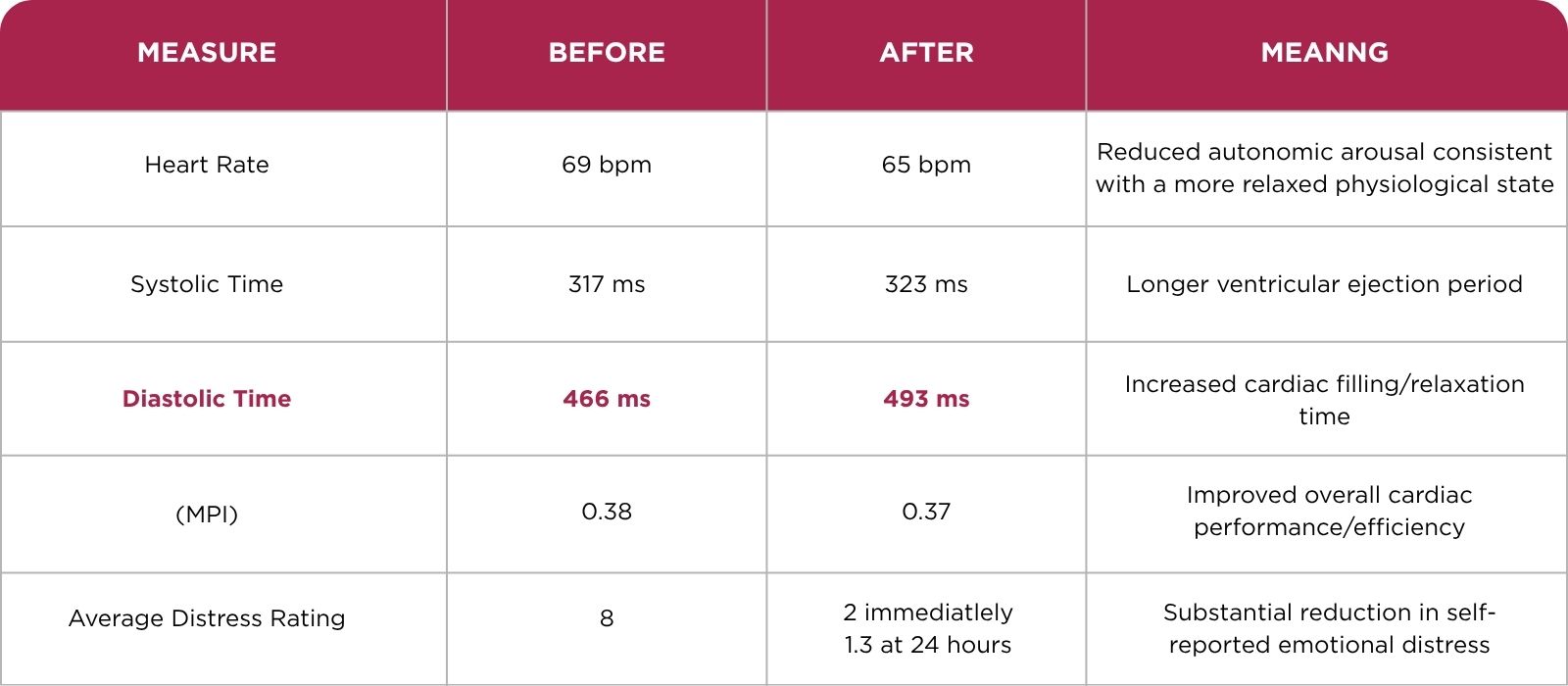
Overall, the reduction in heart rate and increase in diastolic time are consistent with a shift toward a more relaxed physiological state following the B.R.A.I.N.S. Technique™ session.
The combined physiological and participant-reported findings suggest that the B.R.A.I.N.S. Technique™ may help the system rapidly recalibrate following acute distress.
Within an average 7–15 minute session, participants reported substantial reductions in emotional intensity, along with shifts in perspective, insight, problem-solving, emotional flexibility, and compassion. These changes are consistent with greater availability of higher-order regulatory and social-emotional processing as the acute stress response settles.
At the same time, heart rate decreased and diastolic time increased following the session, findings consistent with a shift toward a more relaxed physiological state and changes in autonomic regulation.
Importantly, the effects were not limited to the immediate session. Participant-reported improvements continued over the following 24–48 hours, suggesting that the shift may persist beyond the initial intervention.
Together, these preliminary findings suggest a rapid shift from acute stress reactivity toward greater physiological regulation, emotional flexibility, cognitive availability, and compassion—with benefits that may continue after the session ends.
Acute stress can affect both emotional functioning and physiological regulation. In this pilot study, participants reported substantial reductions in distress while cardiac measurements also shifted toward a more relaxed physiological pattern, including a lower heart rate and longer diastolic time following the B.R.A.I.N.S. Technique™ session.
This matters because the findings suggest that B.R.A.I.N.S. Technique™ may influence more than how distressed a person says they feel. The simultaneous changes in self-reported distress and cardiac physiology support further investigation into whether the technique helps the body and nervous system recover more efficiently after acute stress.
Potential implications include:
Faster return to emotional regulation
Greater access to perspective, problem-solving, and compassion
Reduced physiological stress activation
Improved ability to function following a distressing event
A possible early-intervention role in reducing persistent post-stress symptoms
Together, the emotional and cardiac findings support further research into B.R.A.I.N.S. Technique™ as a rapid intervention for acute stress recovery.
B.R.A.I.N.S. Technique™ is currently being explored through a neuroscience-informed working model, not a proven neurological mechanism.
Acute stress is known to alter coordination among three large-scale brain networks involved in detecting significance, directing attention, executive functioning, and internal processing: the Salience Network, Central Executive Network, and Default Mode Network.
One hypothesis is that when a highly salient distressing moment remains emotionally and physically activated, the brain may continue to respond as though that information requires immediate attention. By identifying the specific Snapshot carrying the greatest intensity and reducing its emotional and physical impact, B.R.A.I.N.S. Technique™ may help the system shift away from this persistent threat-oriented state, allowing more flexible executive and reflective processing to resume.
The proposed mechanism is consistent with what is known about the triple-network response to acute stress and with the Network Balance Model of Trauma and Resolution proposed in EMDR research.
This does not establish that B.R.A.I.N.S. Technique™ changes these networks directly. Neuroimaging and other objective physiological research would be needed to test this hypothesis.
This working model provides a testable framework for future research. The physiological and participant-reported changes observed to date offer an early signal worth investigating, while the underlying neurological mechanisms remain to be established. Future research can help determine where the model is accurate, where it needs refinement, and what is actually occurring in the brain and nervous system during the B.R.A.I.N.S. Technique™.
The goal is not to make the data fit a theory, but to let continued research reveal what is actually happening.